
For two years now, we’ve all understood that to appear in recommendations from ChatGPT, Gemini, or Claude, our website needs to be written with these engines in mind. But what about the people, the target audience who ask the questions and ultimately visit the site? We have entered an era in which our website must speak to two very different audiences: humans and AI engines.
The GEO era: Why AI engines are making us recalculate our route
Many of us turn to AI engines like ChatGPT and Gemini several times a day. We ask complex questions on every subject, describe a problem, and expect an accurate answer and a relevant recommendation.
For businesses and organizations, this changes the rules of the game. Appearing in Google search results is no longer enough. We want AI engines to know us too, to understand what we specialize in, and to recognize us as a relevant source when a potential customer is looking for a solution.
But behind the technical term GEO lies a far more interesting marketing challenge: How do we get an AI engine to understand our customers’ needs and pain points, and connect them to our website when we offer a relevant solution?
This is the delicate dance of the GEO journey, one that we, as marketers, know how to build and direct.
Step 1: It all starts with understanding the customer’s needs
Despite all the technological developments, the starting point of every good marketing strategy remains exactly what it always was: the customer.
Before we think about how an AI engine will read our site, we need to understand who is on the other side of the search. What is our potential customer looking for? What problem are they trying to solve, and what worries them? What questions do they ask before making a decision, and what information will help them feel they’ve found the right solution?
Today, people’s queries to AI engines are becoming more detailed and complex. Instead of simply searching for a “queue management system,” for example, a customer might ask an AI engine something like: “How can I shorten wait times at a large clinic, improve the patient experience, and manage appointments that come in from both the website and the front desk?” This question tells us much more about the customer’s real need than the pair of keywords we settled for when SEO stood alone. It reveals the business problem, the work environment, and the desired outcome.
That’s why planning a website in the AI era must start with a deep understanding of the target audience’s questions and needs. Strategic thinking plays a much larger role here. Planning becomes more important, demands greater precision, and replaces the basic need for a list of keywords to rank for.
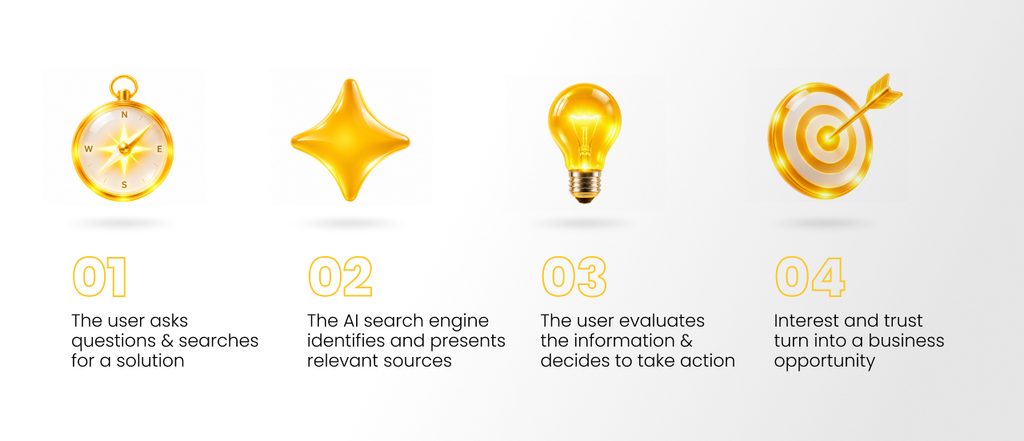
Step 2: How do we teach AI engines to understand what sets us apart?
Once we understand what the customer is looking for, the next challenge is making sure AI engines also understand that our company offers a relevant answer. AI engines don’t necessarily settle for simple keyword matching. Depending on the engine and how it works, they can analyze the context of a question, find information from different sources, and put together an answer that addresses the need the user described.
Our website therefore needs to provide clear, in-depth, and reliable information that connects our customers’ needs with the solutions we offer. It’s not enough to write that we are “a leading company providing innovative, advanced solutions.” Our content needs to explain more precisely what we do, who our solutions are for, which challenges they solve, and what value they deliver. The more accurate, focused, and grounded in real knowledge our content is, the greater its potential to be recognized as a relevant source for a wide range of questions.
This is also where the site’s structure and architecture come into play: the content hierarchy, the links between pages, the technical aspects of search engine accessibility, professional content, case studies, and signals of credibility and expertise.
GEO doesn’t replace traditional SEO
It’s important to remember that GEO doesn’t replace traditional SEO. It broadens our perspective. The fundamentals of quality organic search optimization are still very important in the age of AI search. The goal isn’t to “persuade” the engine to recommend us at any cost, but to build a digital presence that enables it to recognize us as a valuable source. Of course, there’s no way to guarantee that the engine will choose to feature us.
Step 3: Bringing the focus back to the user experience
Let’s say we’ve succeeded. The AI engine identified our company as a relevant source and featured it in its answer, and the user clicked the link and came to our site. Is the mission accomplished? Far from it.
In fact, this is where one of the most important stages of the journey begins. Visitors arrive with certain expectations. They asked a question, received a recommendation, and now want to make sure they’ve come to the right place.
We have a very short window to convince them to stay.
They need to understand almost immediately what the company does, what it offers, and whether its solution fits the problem they came with. At this point, it’s no longer enough for the content to be clear to AI engines. It needs to be clear, accessible, and persuasive for people.
The key message, headings, design, page structure, and user experience must all work together to create an immediate sense of relevance. If a user asked about a queue management solution for clinics but landed on a page that talks in general terms about “innovation in the service experience” without presenting the relevant solution, they may leave, even if our system is a perfect fit.
Bringing customers to the site is only half the job. The other half is helping them see they’ve come to the right place.
Step 4: From relevance to trust, and from trust to action
Even after we’ve convinced users to stay, the journey isn’t over. Now we need to help them move from a first impression to a deeper understanding, build trust, and ultimately make a decision.
When planning the website, we focus on a few key points:
- Content that provides real answers: clear explanations of the solutions, their benefits, and how they’re implemented.
- Examples of projects, customers, and results that demonstrate our capabilities.
- A good user experience and clear navigation that make relevant information easy to find.
- Messaging and design that build trust: professional, precise, and consistent language that conveys credibility.
- A clear call to action: a prominent contact form, a meeting scheduler, a demo request, or any other relevant business action.
All of these are an integral part of a successful process. Ultimately, even if AI engines mention our company again and again, that exposure won’t necessarily translate into business inquiries.
Real success happens when digital visibility, content, user experience, and calls to action come together in one continuous, compelling journey.
The delicate dance of GEO is a tango: Human, machine, human
We start with people and their needs. We move on to the AI engine, which needs to understand the information, recognize its relevance, and decide which sources to present. Then we come back to people, who need to feel confident, develop trust, understand the value, and choose whether to move forward with us.
Each of these stages has its own rules, but none of them can exist on its own.
A website built only for AI engines may miss the emotional and business connection with the user. On the other hand, an impressive, well-designed site that fails to explain to search engines what it does and which problems it solves may be left out of the conversation. The challenge is to strike the right balance between the two, and that’s exactly why GEO isn’t just a task for SEO specialists. It calls for integrated thinking across marketing strategy, site specification, content, UX/UI, development, and performance analysis.
Our website must connect every part of the journey and speak two “languages”: The language of people and emotion, and the language of AI engines
The significant change isn’t only in the technology. It’s in how we approach planning our digital presence. This strategic stage has become even more important today, and every action in the execution stages flows from it.
At IMAGINET, we believe an effective website must connect every part of this journey and speak both languages: from understanding the target audience and its needs, through building content and digital infrastructure suited both to the new world of search and to a user experience that turns interest into trust and trust into business opportunity. Because even in an era when AI is becoming an integral part of how customers find us, the one who starts the journey and makes the business decision is still a person.